

Have you come across the term “CX” while reading about business, marketing, or customer service and wondered what it means? If so, you’re not alone. Understanding the CX meaning is essential because it plays a major role in how businesses attract, satisfy, and retain customers. In today’s competitive market, companies no longer compete only on price or product quality, they also compete on the experience they provide.
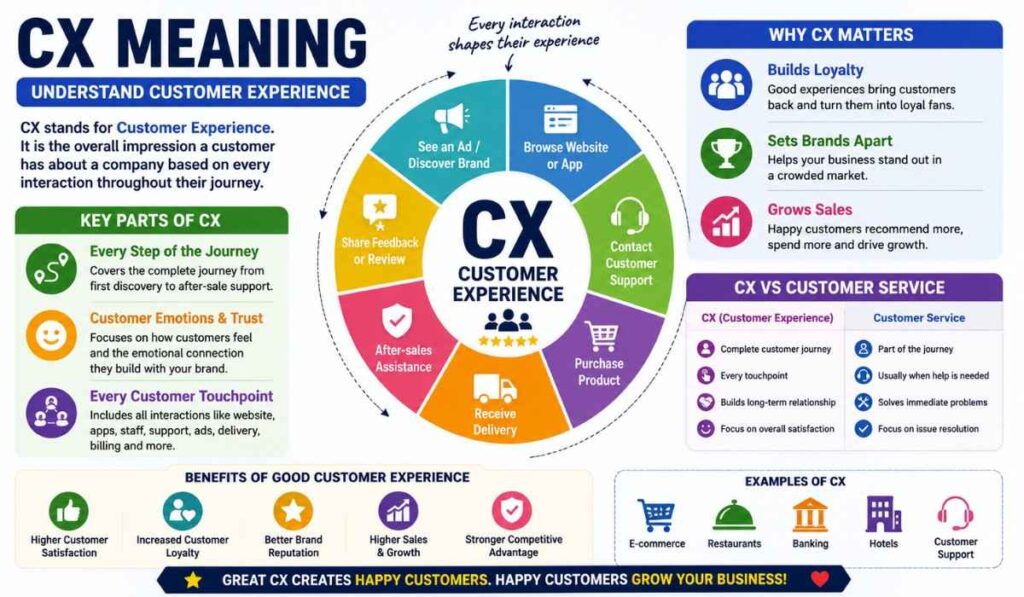
In simple words, CX stands for Customer Experience. It refers to how customers feel and think about a company based on every interaction they have with it. From seeing an advertisement for the first time to visiting a website, making a purchase, contacting customer support, and even receiving after-sales service, every step contributes to the overall customer experience.
This guide explains the CX meaning, why it matters, its key components, real-life examples, and how businesses can improve customer experience to build long-term relationships.
Quick Answer
CX stands for Customer Experience, which refers to the overall impression a customer forms about a company through every interaction they have with it. It is not limited to a single purchase or conversation but includes the complete journey, from discovering a brand for the first time to receiving after-sales support. Every stage matters, whether a customer is browsing a website, seeing an advertisement, reading reviews, speaking with customer service, making a purchase, or using a product. Each of these interactions shapes how the customer feels about the business and influences their decision to return in the future.
A positive customer experience helps businesses build trust, improve customer satisfaction, and encourage long-term loyalty. When customers enjoy smooth navigation, quick support, timely deliveries, and high-quality products or services, they are more likely to recommend the brand to others and become repeat buyers. On the other hand, poor communication, delayed deliveries, or unhelpful customer service can leave a negative impression and drive customers towards competitors. This is why companies invest heavily in improving customer experience, ensuring that every touchpoint delivers value and creates a lasting positive relationship with their customers.
Read Also: BG Meaning in Chat
What Does CX Mean?
Customer Experience, commonly abbreviated as CX, is the complete journey a customer has with a business. Unlike a single transaction or conversation, CX focuses on every interaction from beginning to end. Whether someone discovers a company through social media, visits its website, purchases a product, contacts support, or leaves a review, each touchpoint influences their opinion of the brand. Businesses that consistently provide smooth, helpful, and enjoyable experiences are more likely to gain loyal customers.
Full Form of CX
The full form of CX is Customer Experience.
The abbreviation is widely used in industries such as:
- Retail
- E-commerce
- Banking
- Hospitality
- Healthcare
- Telecommunications
- Travel
- Technology
- Customer Support
Many companies even have dedicated CX teams whose responsibility is to improve the overall customer journey.
Why CX Is Important
Customer experience has become one of the biggest factors influencing business success. Even if two companies sell similar products at similar prices, customers often choose the one that provides a better experience. A positive CX helps businesses build trust, increase customer satisfaction, and encourage repeat purchases.
Builds Customer Loyalty
One of the greatest benefits of good customer experience is customer loyalty. When customers consistently receive excellent service, they are more likely to return.
For example:
- They continue buying from the same brand.
- They recommend the company to family and friends.
- They leave positive online reviews.
- They become long-term customers.
Loyal customers also tend to forgive small mistakes because they trust the company.
Helps Businesses Stand Out
Today’s customers have many choices. If two companies sell similar products, the one offering a better customer experience usually gains the advantage.
Good CX helps businesses differentiate themselves by providing:
- Friendly customer support.
- Easy-to-use websites.
- Fast delivery.
- Simple return policies.
- Personalised recommendations.
- Quick problem resolution.
These small improvements create a better overall experience than competitors.
Increases Sales and Growth
Happy customers often spend more money. When customers enjoy interacting with a business, they feel confident purchasing again.
Good customer experience can also lead to:
- Higher repeat purchases.
- Better customer retention.
- Increased referrals.
- Positive online reviews.
- Stronger brand reputation.
As customer satisfaction improves, businesses often experience steady long-term growth.
Key Parts of Customer Experience (CX)
To fully understand the CX meaning, it’s important to know what creates a great customer experience. CX is not limited to a single interaction or purchase. Instead, it combines every stage of the customer’s journey with a business. Several factors work together to shape how customers think and feel about a brand. When businesses focus on these areas, they can provide a smoother and more enjoyable experience.
Every Step of the Customer Journey
Customer experience begins long before someone makes a purchase. It starts the moment a person first hears about a company and continues even after they have bought a product or service.
A typical customer journey includes:
- Seeing an advertisement
- Visiting the company’s website
- Comparing products or services
- Making a purchase
- Receiving the product
- Contacting customer support if needed
- Receiving after-sales service
- Sharing feedback or writing reviews
Each step affects the customer’s overall opinion of the business. For example, imagine someone shopping for a laptop online. They discover a retailer through a social media advertisement, easily browse the website, find the information they need, place an order without difficulty, receive the laptop on time, and get quick assistance when they have a question. Every positive interaction contributes to an excellent customer experience.
On the other hand, if the website is confusing, the delivery is delayed, or customer support is unhelpful, the customer may decide not to buy from that company again. This is why businesses carefully analyse every stage of the customer journey and look for ways to improve it.
Customer Emotions and Trust
Customer experience is not just about products or services it is also about how customers feel during every interaction. Positive emotions help businesses build stronger relationships with their customers. When people feel valued, respected, and supported, they are more likely to trust the brand.
Good customer experience often creates feelings such as:
- Happiness
- Satisfaction
- Confidence
- Trust
- Appreciation
- Loyalty
Negative experiences, however, can lead to:
- Frustration
- Disappointment
- Confusion
- Anger
- Loss of trust
For example, if a customer receives quick help when facing a problem, they are likely to remember the company positively. However, if they struggle to contact customer support or receive poor service, their trust in the business may decrease.
Building trust is one of the most valuable outcomes of good customer experience because trusted brands often enjoy stronger customer loyalty and positive word-of-mouth recommendations.
Every Customer Touchpoint
A touchpoint is any moment when a customer interacts with a business. Modern companies communicate with customers through many different channels, making every touchpoint important.
Some common customer touchpoints include:
- Company website
- Mobile application
- Social media pages
- Online advertisements
- Email communication
- Live chat support
- Phone support
- Physical stores
- Product packaging
- Delivery service
- Billing and invoices
- Customer feedback surveys
Each interaction contributes to the customer’s overall impression. For example, a beautifully designed website creates a positive first impression. Fast customer support strengthens trust. Secure payment systems increase confidence, while timely delivery improves satisfaction. Successful businesses aim to provide a consistent experience across every touchpoint so that customers receive the same quality of service wherever they interact with the brand.
Examples of CX in Everyday Life
Customer experience can be found in almost every industry. Whether you’re shopping online, visiting a restaurant, booking a hotel, or contacting your bank, your overall experience influences whether you’ll return in the future.
Online Shopping
A customer visits an e-commerce website to buy a pair of shoes. The website loads quickly, product descriptions are clear, payment is simple, delivery arrives on time, and the customer receives regular order updates.
Result: A positive customer experience.
Restaurant Visit
A family visits a restaurant where they are welcomed warmly, served quickly, and enjoy delicious food in a clean environment.
Result: They are likely to return and recommend the restaurant to others.
Banking
A customer uses a banking app to transfer money. The app works smoothly, the transaction is completed instantly, and a confirmation message is sent immediately.
Result: The customer feels confident using the bank’s digital services.
Hotel Stay
Guests check into a hotel where the staff are polite, the room is clean, and any requests are handled promptly.
Result: They leave positive reviews and may choose the same hotel for future trips.
Customer Support
A customer contacts a company because of a damaged product. The support team responds quickly, apologises for the inconvenience, and arranges a replacement without unnecessary delays.
Result: Even though there was an initial problem, the excellent service creates a positive customer experience.
These examples show that customer experience is shaped by every interaction—not just the final purchase.
CX vs Customer Service
Many people think Customer Experience (CX) and Customer Service are the same, but they have different meanings.
| Feature | Customer Experience (CX) | Customer Service |
| Definition | The customer’s overall journey with a company | Assistance provided when customers need help |
| Covers | Every interaction before, during, and after a purchase | Usually specific support interactions |
| Focus | Overall satisfaction and relationship | Solving customer issues |
| Includes | Website, advertising, sales, delivery, support, feedback | Phone support, email support, live chat, in-store assistance |
| Goal | Build long-term loyalty and trust | Resolve customer problems quickly |
In simple terms, customer service is one part of customer experience. A company may have excellent customer service, but if its website is confusing or deliveries are always late, the overall customer experience may still be poor. Likewise, a business that delivers a seamless journey across every touchpoint is more likely to create satisfied, loyal customers.
How Companies Improve CX
Providing a great customer experience doesn’t happen by chance. Successful businesses constantly evaluate their customer journey and look for ways to make every interaction easier, faster, and more enjoyable. Here are some of the most effective ways companies improve CX.
Listen to Customer Feedback
Customer feedback helps businesses understand what they are doing well and where improvements are needed.
Companies collect feedback through:
- Online surveys
- Product reviews
- Social media comments
- Customer support conversations
- Email questionnaires
By listening to customers, businesses can identify common problems and make meaningful improvements.
Provide Excellent Customer Support
Friendly and responsive customer support plays a huge role in customer experience.
Customers appreciate businesses that:
- Respond quickly
- Solve problems efficiently
- Communicate politely
- Offer multiple support channels
- Follow up after resolving issues
Excellent support often turns unhappy customers into loyal ones.
Improve Website and App Experience
For many businesses, the website or mobile app is the customer’s first impression.
A good digital experience includes:
- Fast loading pages
- Easy navigation
- Clear product information
- Secure payment options
- Mobile-friendly design
- Simple checkout process
An easy-to-use website encourages customers to stay longer and complete their purchases.
Personalise the Experience
Customers appreciate personalized experiences.
Businesses often personalise interactions by:
- Recommending products based on previous purchases
- Sending personalised emails
- Offering birthday discounts
- Remembering customer preferences
- Providing relevant content
Personalisation makes customers feel valued and strengthens their relationship with the brand.
Train Employees
Employees represent the company during every customer interaction.
Businesses invest in training so staff can:
- Communicate professionally
- Resolve complaints calmly
- Understand customer needs
- Deliver consistent service
Well-trained employees contribute significantly to a positive customer experience.
Benefits of Good Customer Experience
A strong customer experience benefits both customers and businesses. Companies that consistently deliver positive experiences often enjoy better long-term success.
Higher Customer Satisfaction
Satisfied customers are more likely to enjoy their interactions with a business and leave positive feedback.
Increased Customer Loyalty
Customers who have positive experiences usually return for future purchases instead of switching to competitors.
Better Brand Reputation
Happy customers often recommend businesses to friends, family, and colleagues.
Positive online reviews also help attract new customers.
Higher Sales
Satisfied customers are more likely to:
- Buy again
- Spend more
- Try additional products
- Recommend the company to others
This naturally contributes to business growth.
Competitive Advantage
In competitive markets, customer experience often becomes the deciding factor. Two companies may sell similar products, but customers usually prefer the one that offers a smoother and more enjoyable experience.
Common Mistakes Businesses Make
Even successful companies sometimes make mistakes that negatively affect customer experience.
Some common examples include:
- Slow customer support responses
- Complicated websites
- Hidden charges
- Poor communication
- Long delivery times
- Difficult return policies
- Ignoring customer feedback
- Inconsistent service across different channels
These issues can frustrate customers and damage trust. Businesses that identify and fix these problems often see significant improvements in customer satisfaction.
Tips to Improve CX
Whether you run a small business or a large organisation, these simple tips can help improve customer experience.
- Understand your customers’ needs.
- Respond to customer enquiries quickly.
- Make your website easy to navigate.
- Deliver products on time.
- Keep communication clear and honest.
- Personalise customer interactions whenever possible.
- Collect feedback regularly.
- Use customer suggestions to improve your services.
- Train employees to provide excellent support.
- Continuously review and improve the customer journey.
Even small improvements at different stages of the customer journey can make a noticeable difference in how customers perceive a business.
Read Also: TOTP Meaning
Frequently Asked Questions
Q1. What does CX mean?
CX stands for Customer Experience. It refers to how customers feel about a business based on every interaction they have with it, from discovering the brand to receiving after-sales support.
Q2. Why is customer experience important?
Customer experience is important because it helps businesses build trust, increase customer satisfaction, encourage repeat purchases, and create long-term customer loyalty.
Q3. What are the main parts of CX?
The main parts of CX include every step of the customer journey, customer emotions, trust, and all customer touchpoints such as websites, mobile apps, customer support, stores, and delivery services.
Q4. Is CX the same as customer service?
No. Customer service is only one part of customer experience. CX covers the entire customer journey, while customer service focuses specifically on helping customers before, during, or after a purchase.
Q5. How can businesses improve customer experience?
Businesses can improve customer experience by providing excellent customer support, listening to customer feedback, improving websites and mobile apps, personalising interactions, and training employees to deliver consistent service.
Q6. What are some examples of customer experience?
Examples include shopping on an easy-to-use website, receiving fast delivery, getting helpful customer support, enjoying a smooth hotel stay, or using a banking app that works efficiently. Every interaction contributes to the overall customer experience.
Conclusion
Understanding the CX meaning is essential for anyone interested in business, marketing, or customer service. Customer Experience goes far beyond a single purchase or support interaction—it represents the complete journey a customer has with a company. Every touchpoint, from discovering a brand to receiving after-sales support, shapes how customers feel and whether they choose to return.
Businesses that focus on delivering excellent customer experiences often enjoy stronger customer loyalty, positive reviews, higher sales, and a better reputation in the market. By listening to customer feedback, improving every stage of the customer journey, and consistently meeting customer expectations, companies can build lasting relationships that benefit both the business and its customers.
As competition continues to grow, delivering an outstanding customer experience is no longer optional; it’s one of the most important factors for long-term success. Whether you’re a business owner, marketer, or customer, understanding the true meaning of CX helps you appreciate why every interaction matters.