

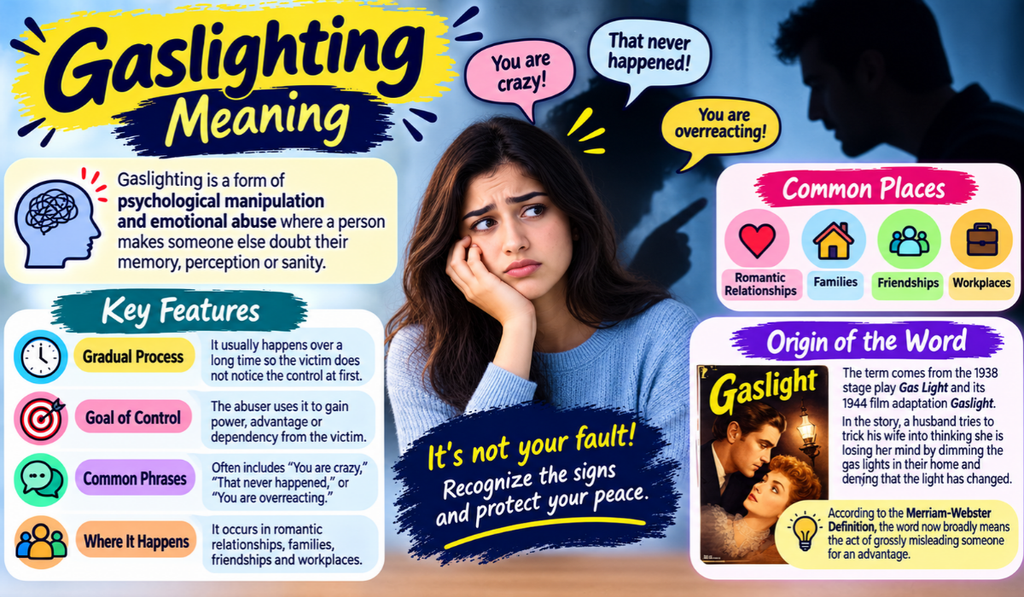
Gaslighting meaning refers to a form of psychological manipulation in which a person repeatedly causes someone else to question their memory, perception, feelings, or understanding of events. It is often associated with emotional abuse and can happen gradually, making it difficult to recognize at first. A person who uses gaslighting may deny things that happened, accuse someone of being overly sensitive, or insist that the other person is imagining problems. Gaslighting can occur in romantic relationships, families, friendships, workplaces, and other social situations. Understanding the gaslighting meaning, common signs, examples, origins, and ways to respond can help people recognize unhealthy patterns and protect their emotional well-being.
Gaslighting Meaning
The gaslighting meaning is the use of manipulation to make another person doubt their own memory, perception, judgment, or reality. Instead of addressing a concern honestly, the person using gaslighting may deny what happened or repeatedly change the story.
Gaslighting is usually not about one disagreement or a simple difference of opinion. It often involves a repeated pattern in which someone’s experiences are dismissed or distorted. Over time, the targeted person may begin to rely on the manipulator’s version of events rather than trusting their own judgment.
What Does Gaslighting Mean in Simple Words?
In simple words, gaslighting means making someone question what they know happened. A person may clearly remember an event, but the other person repeatedly tells them that it never happened or that they misunderstood it. For example, imagine someone makes a hurtful comment and later says, “I never said that. You must have imagined it.” If this type of denial happens repeatedly and causes the other person to doubt their own memory, it can be an example of gaslighting.
Read Also: What Is a Pookie || Crab Puns || 333 Angel Number Meaning
How Does Gaslighting Work?
Gaslighting often develops gradually rather than happening in one obvious incident. A manipulator may start with small denials or dismissive comments and gradually make the other person question their judgment. Because each individual incident may seem minor, the overall pattern can be difficult to identify. Over time, repeated manipulation can affect a person’s confidence. They may start asking others to confirm what happened, apologizing even when they have done nothing wrong, or avoiding conversations because they are worried about being told that their feelings are unreasonable.
Common Gaslighting Tactics
People who use gaslighting may rely on different tactics depending on the situation. Some common examples include:
- Denying events that actually happened.
- Telling someone that they are remembering things incorrectly.
- Calling someone “too sensitive” when they express hurt.
- Changing details of a previous conversation.
- Blaming the other person for their own behavior.
- Minimizing someone’s feelings or concerns.
- Accusing someone of being irrational or dramatic.
- Using other people’s opinions to make the target doubt themselves.
- Pretending not to understand an obvious concern.
- Repeatedly questioning someone’s memory or judgment.
One tactic by itself does not automatically prove that someone is gaslighting another person. People can genuinely remember events differently or misunderstand conversations. Gaslighting is more accurately understood as a repeated pattern of manipulation that undermines another person’s trust in their own perception.
Signs of Gaslighting
Recognizing gaslighting can be challenging because it may happen slowly. The person experiencing it may initially believe that they are simply misunderstanding situations or making mistakes. As the pattern continues, however, they may notice changes in their confidence and behavior. Someone experiencing gaslighting may frequently question their memory, apologize unnecessarily, or feel confused after conversations. They may also feel that they need evidence or another person’s confirmation before trusting their own recollection of an event.
Signs You May Be Experiencing Gaslighting
Some common signs include:
- You constantly question whether your memory is correct.
- You frequently apologize even when you are not sure what you did wrong.
- You feel confused after ordinary conversations.
- You regularly hear that you are “too sensitive.”
- You feel nervous about bringing up problems.
- You start relying heavily on someone else’s version of events.
- You feel that your feelings are repeatedly dismissed.
- You find yourself keeping evidence to prove what happened.
- You have become less confident in your decisions.
- You regularly wonder whether you are the problem.
These experiences can have many possible causes, so they should be considered in context. A disagreement, mistake, or difference in memory does not automatically mean gaslighting is taking place. The repeated nature of the behavior and its effect on the person’s confidence are important factors to consider.
Common Gaslighting Phrases
Language is often an important part of gaslighting. A person attempting to manipulate someone may repeatedly use statements that challenge their memory, emotions, or perception of reality.
Common phrases associated with gaslighting include:
| Phrase | Possible Effect |
| “That never happened.” | Makes someone question their memory |
| “You are imagining things.” | Dismisses their perception |
| “You are too sensitive.” | Makes their emotional response seem unreasonable |
| “You’re overreacting.” | Minimizes their concern |
| “You’re crazy.” | Attacks their confidence and judgment |
| “I was only joking.” | Avoids responsibility for hurtful behavior |
| “Everyone agrees with me.” | Creates pressure to doubt oneself |
| “You always misunderstand me.” | Shifts responsibility onto the other person |
A single phrase does not necessarily constitute gaslighting. For example, people sometimes say “you’re overreacting” during ordinary arguments. The concern is when these statements become part of a repeated pattern designed to dismiss someone’s experience and make them distrust themselves.
Examples of Gaslighting
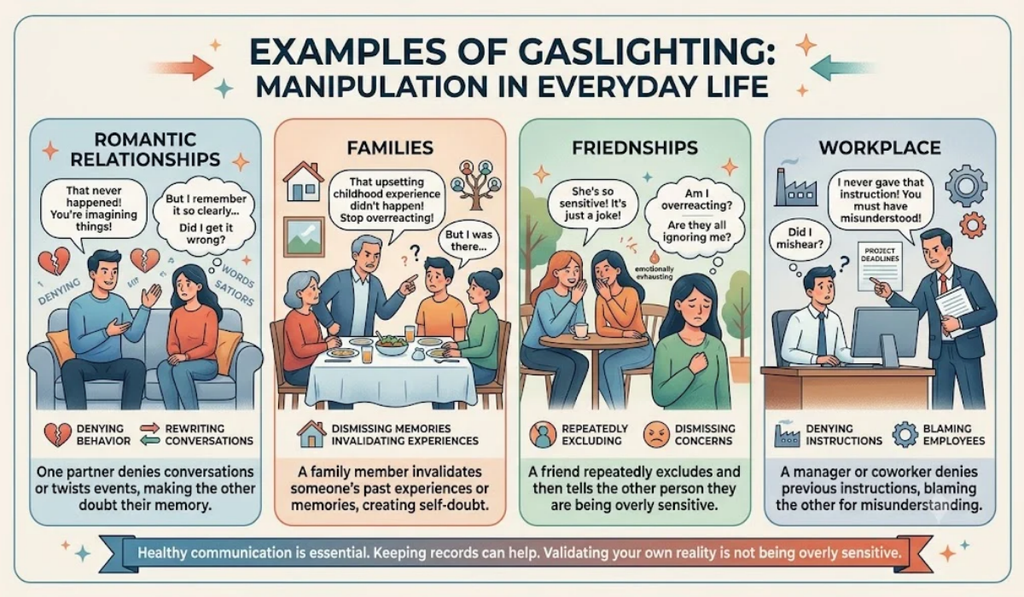
Gaslighting can occur in many different relationships and environments. The basic pattern is similar: one person repeatedly attempts to undermine another person’s confidence in their own perception or memory. The examples below can help explain how gaslighting may appear in everyday situations. They should not be used as a diagnosis of a specific relationship because context and repeated behavior matter.
Gaslighting in Romantic Relationships
In a romantic relationship, gaslighting may involve one partner denying hurtful behavior or rewriting conversations. For example, one partner may clearly remember an argument, while the other repeatedly insists that the argument never happened. Another example is blaming a partner for behavior that the manipulator themselves displayed. If this happens repeatedly, the targeted person may begin questioning their judgment and avoiding difficult conversations altogether.
Gaslighting in Families
Gaslighting can also occur between family members. A parent, sibling, or other relative may dismiss someone’s memories or insist that an upsetting childhood experience did not happen. Family dynamics can make this particularly complicated because people often have different memories of the same events. A disagreement about the past is not necessarily gaslighting. The concern arises when someone repeatedly attempts to invalidate another person’s experience or manipulate them into doubting themselves.
Gaslighting in Friendships
Friendships can also involve unhealthy manipulation. A friend might repeatedly exclude someone and then insist that the person is imagining the exclusion or being overly sensitive. If someone consistently dismisses concerns rather than discussing them honestly, the friendship can become emotionally exhausting. Healthy friendships generally allow people to express concerns without being repeatedly made to question their own reality.
Gaslighting in the Workplace
Gaslighting can sometimes occur in professional environments. A manager or coworker might deny giving an instruction, despite previously providing it, and then blame an employee for misunderstanding. Workplace gaslighting may be particularly difficult when the behavior affects responsibilities or performance. Keeping accurate records of important instructions, deadlines, and decisions can help reduce confusion and provide a clear record of workplace communication.
Why Do People Gaslight Others?
There is no single reason why someone may use gaslighting behavior. In some situations, it may be connected to a desire for control, avoidance of responsibility, or an attempt to gain an advantage.
It is important not to assume that every person who lies, disagrees, or behaves defensively is deliberately gaslighting someone. Gaslighting describes a particular pattern of psychological manipulation rather than every form of dishonesty or conflict.
Control and Power
One possible purpose of gaslighting is gaining control over another person. If someone begins to distrust their own judgment, they may become more dependent on the person providing the alternative version of events. This can create an unhealthy power imbalance. The manipulator’s opinions may gradually become more influential, while the targeted person’s confidence in their own decisions becomes weaker.
Avoiding Responsibility
Gaslighting can be used in addition to avoiding accountability. Rather than accept that they made a mistake or made an error in their behavior, this individual may deny the incident occurred, or at least focus attention on what the other person did to react. Instead of talking about why there a hurtful comment was made, they may assert that the other person is “too sensitive.” And this changes the topic from what it did originally.
Effects of Gaslighting
Repeated gaslighting can affect a person’s confidence and emotional well-being. When someone is repeatedly told that their memories, feelings, or perceptions are wrong, they may eventually begin to distrust themselves. The effects can vary from person to person. Some people may become anxious or withdrawn, while others may constantly seek reassurance before making decisions. Recognizing these effects can be an important step toward understanding an unhealthy relationship dynamic.
Common Emotional Effects
Possible effects of prolonged gaslighting include:
- Self-doubt
- Confusion
- Anxiety
- Low self-confidence
- Emotional exhaustion
- Difficulty making decisions
- Increased dependence on others
- Feeling isolated
- Constantly seeking reassurance
- Difficulty trusting one’s own memories
These effects are not unique to gaslighting and can occur for many reasons. If emotional distress is persistent or significantly affecting daily life, speaking with a qualified mental health professional can provide appropriate support.
Gaslighting vs Lying
Gaslighting and lying are similar but different. Lying, in general, means that the intention is to purposefully lie or provide factual wrong information. Gaslighting, on the other hand, takes it a step beyond denying or dismissing: it actively chips away at another person’s confidence in their own memory and judgment for many repetitions of deception. A person could even lie about where they were on any given evening. This would be gaslighting, if you insist that the other person has made this entire thing up and make them question your memory reliability.
| Lying | Gaslighting |
| Involves false information | Involves psychological manipulation |
| Can happen as a single incident | Often occurs as a repeated pattern |
| May hide a specific fact | Can undermine trust in one’s own perception |
| Does not always target someone’s confidence | Often causes self-doubt |
| Can occur without emotional manipulation | Frequently involves emotional manipulation |
Gaslighting vs Normal Disagreement
Not every disagreement is gaslighting. People can remember the same event differently, misunderstand conversations, or have different opinions without intentionally manipulating each other. A healthy disagreement allows both people to express their perspectives. Gaslighting is different because it involves a repeated pattern that dismisses or distorts someone’s experience and may cause them to lose confidence in their own perception.
How to Tell the Difference
Consider the overall pattern rather than focusing on one sentence. Ask yourself whether the other person is willing to discuss the disagreement honestly or whether they repeatedly deny events, dismiss your feelings, shift blame, and make you question your own judgment. Healthy communication can include phrases such as “I remember it differently” or “I didn’t intend it that way.” These statements acknowledge that people can have different perspectives without automatically invalidating the other person’s experience.
Origin of the Word Gaslighting
The term gaslighting comes from the 1938 stage play Gas Light and its later film adaptations, including the 1944 film Gaslight. In the story, a husband attempts to manipulate his wife into believing that she is losing her mind. One of the story’s memorable elements involves the gas lights in their home. When the wife notices that the lights appear to dim, her husband denies that anything has changed. The manipulation makes her question her own perception, which helped inspire the modern meaning of the word “gaslighting.”
How Gaslighting Became a Modern Term
The word eventually moved beyond the fictional story and became a broader term for psychological manipulation. Today, it is commonly used when discussing relationships, emotional abuse, workplace behavior, and other situations involving repeated attempts to undermine someone’s perception. Because the term has become popular online, it is sometimes used too broadly. Not every lie, disagreement, or unpleasant interaction should be labeled gaslighting. Using the term accurately helps distinguish serious manipulation from ordinary conflict.
How to Respond to Gaslighting
Responding to suspected gaslighting can be difficult, particularly when your confidence has already been affected. One useful approach is to slow down conversations and avoid feeling pressured to immediately accept another person’s version of events. Keeping private notes about important conversations, dates, and decisions may also help you maintain a clearer record. If the situation involves emotional abuse or feels unsafe, consider reaching out to someone you trust or a qualified professional for support.
Practical Steps to Consider
If you believe you are experiencing gaslighting, consider these steps:
- Trust your feelings enough to investigate them rather than immediately dismissing them.
- Keep a private record of important conversations when appropriate.
- Save relevant messages or emails.
- Talk with a trusted friend or family member.
- Set clear boundaries around disrespectful conversations.
- Avoid getting trapped in endless arguments about your memory.
- Consider professional support if the situation is seriously affecting you.
- Prioritize your safety if the relationship involves threats or abuse.
You do not have to prove every detail of an argument before taking your feelings seriously. If a relationship consistently leaves you confused, frightened, isolated, or unable to trust yourself, seeking outside support can be an important step.
Frequently Asked Questions About Gaslighting Meaning
Q1. What is the gaslighting meaning?
Gaslighting meaning refers to a pattern of psychological manipulation in which someone causes another person to question their memory, perception, feelings, or understanding of events. It is often associated with emotional abuse.
Q2. What is an example of gaslighting?
An example of gaslighting is repeatedly denying that an event happened when someone remembers it clearly and using statements such as “That never happened” or “You are imagining things” to make them doubt themselves.
Q3. Is gaslighting emotional abuse?
Gaslighting can be a form of emotional abuse, particularly when it is repeated and used to control, intimidate, or undermine another person’s confidence. However, context and the overall pattern of behavior are important.
Q4. Where does the word gaslighting come from?
The term comes from the 1938 play Gas Light and its film adaptations. The story involves a husband manipulating his wife into believing that she is losing her mind, including by denying changes in the gas lighting around their home.
Q5. Is every disagreement gaslighting?
No. A disagreement can happen when two people genuinely remember an event differently or have different opinions. Gaslighting involves a repeated pattern of manipulation that can cause someone to distrust their own memory or perception.
Q6. How can I respond to gaslighting?
You can keep records of important interactions, talk to trusted people, establish boundaries, and seek professional support when needed. If you feel threatened or unsafe, prioritize your safety and seek appropriate help.
Conclusion
The gaslighting meaning describes a form of psychological manipulation in which someone repeatedly causes another person to doubt their memory, perception, feelings, or judgment. It can happen in romantic relationships, families, friendships, and workplaces, and it often develops gradually through repeated denial, blame, minimization, and other manipulative behaviors.
Understanding the signs of gaslighting can make unhealthy patterns easier to recognize. At the same time, it is important not to label every disagreement or lie as gaslighting. If a repeated pattern is damaging your confidence or emotional well-being, talking with someone you trust or seeking professional support can help you understand the situation and decide what steps are right for you.
Read Also: HBD Meaning in Slang || Hard Launch Meaning || Snowball Kiss Meaning in Text