

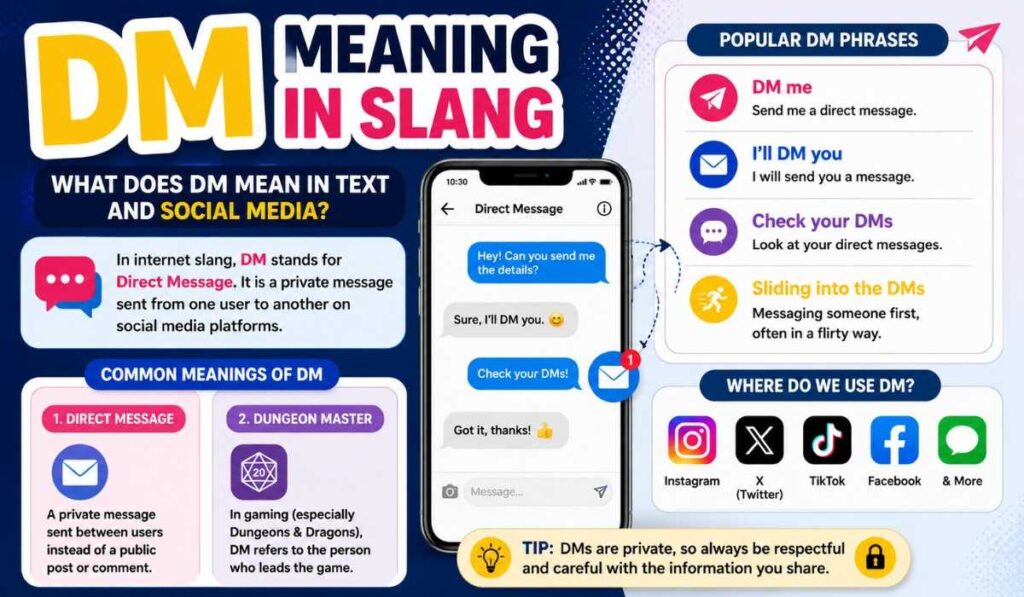
If you have ever seen someone write “DM me,” “check your DMs,” or “I’ll DM you later,” you may have wondered about the DM meaning in slang. In internet and social media slang, DM usually stands for “direct message.” A DM is a private message sent from one person to another on platforms such as Instagram, X (formerly Twitter), TikTok, Facebook, and other social networking apps. Unlike comments or public posts, direct messages are generally meant for private conversations.
The term DM can be used as both a noun and a verb. Someone might say, “Check your DM,” meaning they have sent a private message, while “I’ll DM you” means they intend to send a private message. The expression “sliding into the DMs” is also widely used, especially when someone sends an unexpected or sometimes flirty message to another person. Although DM most commonly means direct message online, it can have another meaning in gaming culture, where DM may refer to a “Dungeon Master” in Dungeons & Dragons.
DM Meaning in Slang: Quick Answer
| Term | Meaning |
| DM | Direct Message |
| DM me | Send me a private message |
| Check your DMs | Look at your private messages |
| I’ll DM you | I’ll send you a private message |
| Sliding into the DMs | Sending someone an unexpected, often flirty message |
| DM in gaming | Dungeon Master, especially in Dungeons & Dragons |
What Is the DM Meaning in Slang?
The most common DM meaning in slang is “direct message.” It refers to a private communication sent between users on a social media platform or another online service. Instead of posting something where everyone can see it, a person can use the platform’s messaging feature to communicate privately with another user.
For example, if someone comments on an Instagram post, everyone who can view that post may be able to see the comment. If the same person sends a DM, the message is generally visible only to the recipient and the sender, depending on the platform and conversation settings.
What Does DM Stand For?
DM stands for “direct message.” The phrase describes a message that is sent directly to another user rather than being shared publicly. The term has become a normal part of everyday internet language. People may use it in casual conversations, business communication, dating conversations, customer service interactions, and social media discussions. Because it is short and easy to understand, “DM” is much more commonly used than writing out “direct message” in informal online conversations.
Is DM a Slang Word?
DM is often considered internet slang or an abbreviation rather than a traditional slang word. It became popular as social media platforms introduced private messaging features and users began looking for shorter ways to describe them. Today, the abbreviation is so widely recognized that people often use it without thinking about its original phrase. Saying “DM me” is now a common way to invite someone to continue a conversation privately.
What Does DM Mean in Text?
In text conversations, DM generally means “direct message,” especially when the conversation is connected to social media. Someone may ask, “Did you DM her?” or say, “I’ll DM you the details.” The exact meaning can depend on the context. If two people are discussing Instagram, TikTok, X, or another social platform, DM almost certainly refers to a direct message. However, in a gaming conversation, DM can have a completely different meaning.
DM Meaning in Chat
When someone uses DM in a chat, they usually mean a private message. For example, “DM me your number” means the person wants you to send the information privately rather than posting it publicly. Another common example is “I sent you a DM.” This simply means that the person has already sent a private message and expects the other person to check their inbox.
DM as a Noun
DM can be used as a noun when referring to the message itself. Examples include:
- “I got a DM from my friend.”
- “Check your DM.”
- “I saw your DM.”
- “Did you read my DM?”
- “She sent me a DM yesterday.”
In each example, the DM refers to a private message.
DM as a Verb
DM can also function as a verb. When someone says “DM me,” they are asking another person to send them a private message.
For example:
- “DM me if you’re interested.”
- “I’ll DM you the address.”
- “DM me your details.”
- “You can DM me anytime.”
- “He DMed me after seeing my post.”
This flexibility is one reason the abbreviation has become so common in online conversations.
Read Also: BRB Meaning in Text
What Does “DM Me” Mean?
“DM me” means “send me a direct message.” It is a simple request asking someone to continue a conversation privately. You may see this phrase in social media bios, comments, posts, advertisements, and everyday conversations. For example, a person selling something online might write, “DM me for the price.” This tells interested users to contact them privately for more information.
Examples of “DM Me”
Here are some common examples of how people use the phrase:
“DM me if you want to join.”
“DM me for more details.”
“DM me your location.”
“DM me when you are free.”
“DM me the photos.”
“DM me if you’re interested.”
In each situation, the person is asking another user to start or continue a private conversation.
What Does “Check Your DMs” Mean?
“Check your DMs” means “look at your direct messages.” Someone may say this after sending you a private message because they want to make sure you notice it. For example, imagine someone comments on your Instagram post saying, “Check your DMs.” This usually means they have sent you additional information privately.
The phrase is particularly common when someone does not want to share information publicly. It can also be used casually between friends who want to continue a conversation away from a public comment section.
Why Do People Say “Check Your DMs”?
There are several reasons someone might ask you to check your DMs. They could have sent you a photo, contact information, an invitation, a business proposal, or simply a personal message. The phrase does not automatically have a romantic meaning. Its meaning depends entirely on the conversation and relationship between the people involved.
What Does “I’ll DM You” Mean?
“I’ll DM you” means “I will send you a private message.” It is commonly used when someone wants to move a conversation from a public space to a private one. For instance, someone might comment, “I have the information you need. I’ll DM you.” This means they do not intend to post the information publicly and will instead send it directly to the person.
Examples of “I’ll DM You”
Here are some natural examples:
“I have the details, so I’ll DM you.”
“I’ll DM you the link.”
“I’ll DM you later.”
“I know the answer. I’ll DM you.”
“I’ll DM you the address once I get there.”
These examples show how DM has become both an abbreviation and a regular verb in online communication.
What Does “Sliding Into the DMs” Mean?
“Sliding into the DMs” is a popular internet slang phrase that means sending someone a private message, often unexpectedly. The expression is particularly associated with flirting, dating, or trying to start a romantic conversation. For example, if someone sees an attractive person’s Instagram profile and sends them a private message without having previously spoken to them, someone might jokingly say that they are “sliding into the DMs.” The phrase is usually playful rather than literal. It does not necessarily mean the message is romantic, but flirting is one of the most common contexts in which the expression is used.
Why Is It Called “Sliding”?
The word “sliding” gives the phrase a playful meaning. It suggests that someone is casually entering another person’s private messages without making a big announcement. Over time, “sliding into the DMs” became a recognizable phrase in internet culture. It can be used seriously, jokingly, or even as a self-aware way of admitting that someone is trying to start a conversation with a crush.
Is Sliding Into the DMs Always Romantic?
No. Although the phrase is often associated with flirting, it can also describe a completely ordinary private message. For example, a person might “slide into the DMs” to ask about a product, collaborate on a project, discuss a shared interest, or simply introduce themselves. The context determines whether the phrase has a romantic or casual meaning.
DM Meaning on Instagram
On Instagram, DM means “direct message.” Instagram users can communicate privately through the platform’s messaging feature instead of leaving a public comment. Someone might say “DM me on Instagram” when they want another user to contact them privately. Businesses and creators also commonly use DMs to answer questions, discuss collaborations, share information, or communicate with followers.
Common Instagram DM Examples
Instagram users may write phrases such as:
“DM me for details.”
“Check your DMs.”
“I’ll DM you.”
“Send me a DM.”
“DM for collabs.”
“DM for booking.”
The meaning is generally the same in each example: contact the person privately.
DM in Instagram Conversations
Instagram DMs can be used for casual conversations between friends as well as professional communication. A person might send a simple “Hey,” share a post, respond to a story, or have a longer private conversation. Because Instagram is heavily focused on visual content, DMs can also involve photos, videos, posts, and other shared media rather than text alone.
DM Meaning on X
On X, formerly known as Twitter, DM also means “direct message.” Users can privately communicate with one another instead of replying publicly to a post. For example, someone might write, “DM me the details,” asking another user to send information privately. This can be useful when the information is personal or when the user simply does not want to continue the conversation publicly.
Public Post vs DM
The biggest difference between a public post and a DM is visibility. A public post can be seen by a broader audience depending on the account’s settings, while a direct message is intended for private communication. This distinction makes DMs useful for conversations that do not belong in a public comment section.
DM Meaning on TikTok
On TikTok, DM also refers to a direct or private message. Users can use messaging features to communicate privately, depending on the platform’s current features and account settings. A creator might ask followers to “DM me” if they want to discuss something privately. Friends can also use messages to share content and continue conversations away from the public comment section.
TikTok DM Examples
A TikTok user might say:
“DM me your favorite song.”
“Check your DMs.”
“I’ll DM you the details.”
“DM me if you want to collaborate.”
Again, the meaning remains “direct message,” even though the platform changes.
Difference Between DM and Comment
One of the easiest ways to understand the DM meaning in slang is to compare a DM with a public comment. A comment is generally attached to a public post, video, or photo and may be visible to other users. A DM, on the other hand, is designed for private communication between users.
| Feature | DM | Comment |
| Meaning | Direct message | Public response |
| Visibility | Generally private | Usually public |
| Main Use | Private conversation | Public discussion |
| Example | “DM me” | “Great post!” |
| Common Platforms | Instagram, X, TikTok and others | Instagram, X, TikTok and others |
The choice between a comment and a DM depends on what the person wants to communicate. A simple reaction might be suitable for a comment, while personal details are usually better shared privately.
Why Do People Use DMs?
People use direct messages for many different reasons. Friends may use them to have private conversations, while businesses may use them to communicate with customers. Social media users may also use DMs to share personal information, photos, invitations, questions, or links. Because the communication happens privately, it can feel more personal than a public comment.
Personal Conversations
Friends often use DMs to talk about things they do not want to discuss publicly. This can include making plans, sharing personal news, or simply having a private conversation. DMs also make it easy to continue a conversation that started in a public comment section.
Business and Professional Communication
Businesses and creators often receive DMs from customers and followers. People may ask about prices, availability, collaborations, bookings, or other details. However, users should still be careful about sharing sensitive personal or financial information through social media messages.
Dating and Flirting
DMs have also become a major part of online dating and flirting. Someone might send a private message to a person they are interested in after seeing their profile or post. This is where expressions such as “sliding into the DMs” are especially common.
DM Meaning in Gaming
Although “direct message” is the most common meaning of DM in internet slang, the abbreviation can mean something completely different in gaming culture. In Dungeons & Dragons, DM commonly stands for “Dungeon Master.” The Dungeon Master is the person who leads the game, manages the fictional world, describes situations, controls non-player characters, and guides the players through the adventure. Therefore, context is extremely important when interpreting DM.
DM as Dungeon Master
If someone says, “Our DM created an amazing campaign,” they are almost certainly talking about a Dungeon Master rather than a direct message. Similarly, “Ask the DM what happens next” would make sense in a Dungeons & Dragons conversation but would sound unusual if someone were talking about Instagram.
Direct Message vs Dungeon Master
The two meanings are easy to distinguish when you look at the surrounding conversation.
| Context | DM Meaning |
| Direct Message | |
| TikTok | Direct Message |
| X | Direct Message |
| Social media | Direct Message |
| Texting about online communication | Direct Message |
| Dungeons & Dragons | Dungeon Master |
| Tabletop gaming | Dungeon Master |
If the conversation is about social media, the DM almost always means direct message. If it is about Dungeons & Dragons, it likely means Dungeon Master.
DM Slang Examples in Everyday Conversations
Understanding examples is one of the easiest ways to learn internet slang. The following conversations show how people commonly use DM in everyday situations.
Example 1: Friends
Person A: “Can you send me those vacation photos?”
Person B: “Sure, I’ll DM you.”
Here, DM means the person will send the photos through a private message.
Example 2: Social Media
Person A: “Where did you buy that jacket?”
Person B: “I’ll DM you the store.”
In this situation, the person does not want to provide the information publicly and will send it privately.
Example 3: Dating
Person A: “He finally slid into my DMs.”
Person B: “Really? What did he say?”
Here, “slid into my DMs” suggests that someone privately messaged another person, possibly with romantic interest.
Example 4: Business
Person A: “How can I order this?”
Person B: “DM us for pricing and availability.”
The business is asking the customer to contact it privately.
Is DM Formal or Informal?
DM is generally informal and is most commonly used in casual digital communication. You are likely to see it in social media posts, text messages, comments, chats, and online conversations. In formal writing, especially when communicating with people who may not understand internet abbreviations, it can be better to write “direct message” instead of simply using DM.
When Should You Use DM?
DM is appropriate when talking about social media or private online messaging in a casual setting. It is especially natural when the people involved already understand the abbreviation.
For example, “DM me when you’re free” sounds completely normal in a casual conversation.
When Should You Avoid DM?
If you are writing a formal business document, academic paper, or professional message for an audience unfamiliar with internet slang, writing “direct message” may be clearer.
For example, instead of saying “DM us for information” in a formal report, you could write “Please contact us through a direct message.”
Similar Internet Slang Terms Related to DM
DM is just one of many abbreviations commonly used online. Learning related expressions can make social media conversations easier to understand.
Some commonly seen terms include:
- PM – Private Message
- IM – Instant Message
- LOL – Laughing Out Loud
- BRB – Be Right Back
- BTW – By the Way
- FYI – For Your Information
- TBH – To Be Honest
- IDK – I Don’t Know
DM and PM can sometimes be used in similar situations, although the exact terminology depends on the platform.
DM vs PM: What Is the Difference?
DM means “direct message,” while PM means “private message.” Both terms describe a private online conversation, but their popularity can vary depending on the platform.
Social media users frequently use “DM” when talking about Instagram, X, TikTok, and similar platforms. “PM” has historically been common on forums, messaging platforms, and online communities.
In everyday internet conversations, the distinction is usually less important than the basic idea: both refer to sending someone a private message.
Read Also: HNY Meaning
How to Respond When Someone Says “DM Me”
If someone says “DM me,” they are asking you to contact them privately. The appropriate response depends on the situation.
If you are interested in the conversation, simply open the person’s profile and send a message if the platform allows it. If you do not know the person or are uncomfortable with the request, you do not have to respond.
Simple Responses to “DM Me”
You could respond with:
“Sure, I’ll DM you.”
“Okay, I’ll message you.”
“Sure, checking my DMs now.”
“I’ll send you a message.”
“Got it, I’ll DM you.”
The best response depends on the relationship and context.
Is “DM Me” Flirty?
“DM me” by itself is not necessarily flirty. It simply means “send me a direct message.” However, the context can make it romantic or suggestive.
For example, if someone comments “DM me” under a person’s attractive photo, it could be interpreted as flirting. On the other hand, a business saying “DM us for details” has no romantic meaning at all. This is why context matters when interpreting social media slang.
Is DM Safe to Use?
Using DMs is generally a normal part of social media communication, but users should remember that private messages are still part of an online platform. It is important to think carefully before sharing personal, financial, or sensitive information. If you receive a message from an unknown account, check the person’s profile and be cautious about suspicious links, requests for money, or attempts to obtain personal information.
Be Careful With Unknown DMs
Not every DM is genuine. Social media accounts can be used for spam, scams, impersonation, and unwanted messages. Avoid clicking suspicious links or sharing passwords, banking details, verification codes, or other sensitive information with strangers through DMs.
Frequently Asked Questions About DM Meaning in Slang
Q1. What does DM mean in slang?
In internet slang, DM usually means “direct message.” It refers to a private message sent from one user to another on a social media platform such as Instagram, X, or TikTok.
Q2. What does “DM me” mean?
“DM me” means “send me a direct message.” It is an informal way of asking someone to contact you privately rather than replying publicly.
Q3. What does “sliding into the DMs” mean?
“Sliding into the DMs” means sending someone a private message, often unexpectedly. The phrase is commonly associated with flirting or attempting to start a romantic conversation, although it can also be used casually.
Q4. Does DM mean Dungeon Master?
Yes. In gaming, particularly Dungeons & Dragons, DM can stand for “Dungeon Master.” The Dungeon Master is the person who leads and manages the tabletop role-playing game. In social media conversations, however, DM usually means “direct message.”
Q5. What does “check your DMs” mean?
“Check your DMs” means “look at your direct messages.” Someone usually says this because they have sent you a private message and want you to read it.
Q6. Is DM the same as a private message?
Generally, yes. DM means “direct message,” while PM means “private message.” Both refer to private online communication, although different platforms may use different terminology.
Conclusion
The most common DM meaning in slang is “direct message.” It refers to a private message sent directly from one user to another rather than a public comment or post. The abbreviation is widely used on social media platforms such as Instagram, X, and TikTok and has become a normal part of everyday internet communication. You can use DM as both a noun and a verb. Someone can say “I got a DM” when referring to a message, or “I’ll DM you” when saying they will send one. Phrases such as “DM me” and “check your DMs” are also common, while “sliding into the DMs” usually describes unexpectedly messaging someone, often with romantic or flirty intentions.
However, DM does not always mean direct message. In Dungeons & Dragons and other gaming conversations, DM can stand for “Dungeon Master.” Therefore, the surrounding context is the best way to determine what someone means. Whether you’re chatting with friends, responding to followers, talking to customers, or simply trying to understand social media slang, knowing the DM meaning in slang makes online conversations much easier to follow.