

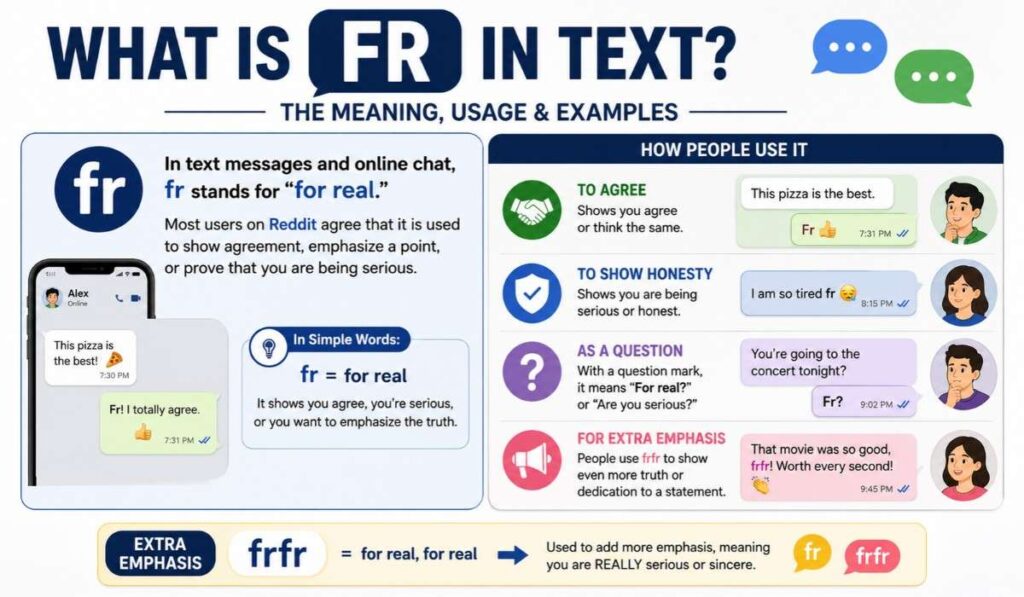
If you have ever received a text message containing “fr” and wondered what the person meant, you are not alone. The abbreviation appears frequently in texting, social media comments, online chats, gaming conversations, and other informal digital spaces. So, what is fr in text? In most cases, fr means “for real.”
People use fr to show that they are being serious, agreeing strongly with someone, or emphasizing that something is genuinely true. For example, if a friend texts, “This movie was amazing,” replying “fr” can mean “for real” or “I completely agree.” The abbreviation is short, quick, and easy to type, which makes it especially popular in casual online conversations.
The exact meaning can depend on the context. “Fr” can be used as a statement, a response, or a question. Someone saying “I’m tired fr” is emphasizing that they are genuinely tired, while “Fr?” usually means “For real?” or “Are you serious?” Understanding the surrounding conversation is therefore important when interpreting this popular texting abbreviation.
What Does FR Mean in Text?
In texting and online conversations, FR most commonly stands for “for real.” It is used to communicate sincerity, agreement, seriousness, or emphasis. Instead of typing the complete phrase “for real,” people often use the shorter form “fr” because it is faster and fits naturally into casual digital communication. For example, imagine that your friend sends you a message saying, “I could sleep for 12 hours today.” If you reply “fr,” you are essentially saying, “For real, I feel the same way.” The abbreviation can therefore work as a quick way of showing that you agree with what someone has said.
FR can also be added to the end of a sentence to emphasize that the statement is genuine. Someone might write, “That was the best burger I’ve ever had fr.” Here, “fr” reinforces the speaker’s opinion and suggests that they genuinely mean what they have said. The abbreviation is generally associated with informal communication. You are more likely to see it in text messages, social media posts, comments, direct messages, gaming chats, and online communities than in formal emails, academic writing, or professional documents.
FR Full Form in Text
The most common full form of FR in text is “for real.” The phrase is used in everyday English to express seriousness, sincerity, agreement, or disbelief depending on how it appears in a conversation. For example, “That exam was difficult fr” means the person genuinely thought the exam was difficult. Similarly, “Fr, I need a vacation” emphasizes that the speaker really wants or needs a vacation.
The abbreviation can also be written in different styles, including “FR,” “fr,” or occasionally “Fr.” In casual texting, lowercase “fr” is particularly common because people often type messages without worrying about capitalization. It is worth remembering that abbreviations can have multiple meanings in different contexts. However, when you see “fr” in a casual text or social media conversation, “for real” is usually the intended meaning.
Read Also: RD Meaning in Text || YNS Meaning Slang
How Is FR Used in Texting?
FR can be used in several ways depending on what the speaker wants to communicate. It can show agreement, emphasize a statement, express seriousness, or ask whether something is actually true. One common use is as a response to another person’s opinion. If someone says, “Winter mornings are the best,” you can reply, “Fr.” In this situation, you are agreeing with the person.
Another use is at the end of a statement. For example, “I’m exhausted fr” means “I’m genuinely exhausted.” The abbreviation adds emphasis and tells the reader that the speaker is being serious. FR can also appear as a question. When someone writes “Fr?” they are usually asking “For real?” or “Are you serious?” The question can express surprise, disbelief, or a request for confirmation.
FR Meaning: Showing Agreement
One of the most common uses of fr is to show agreement. When someone says something that you strongly agree with, replying “fr” is a quick way to say “I agree,” “Exactly,” or “That’s true.”
For example:
- Person A: “Coffee tastes better in the morning.”
- Person B: “Fr.”
Here, Person B is agreeing with Person A. The response is short, but its meaning is clear in the context.
Another example could be:
- Person A: “Delhi traffic can be exhausting.”
Person B: “Fr, especially during rush hour.”
In this case, “fr” introduces an agreement before the person adds more information. Because of this usage, FR often works as a conversational reaction rather than a complete sentence. Its meaning comes from the message immediately before it.
FR Meaning: Showing Honesty or Seriousness
FR can also be used to emphasize that someone is telling the truth or speaking seriously. When placed at the end of a statement, it can make the message sound more sincere.
For example:
- “I’m really tired fr.”
This means the person is genuinely tired and is emphasizing that they are not exaggerating.
Another example is:
- “I really want to travel this year fr.”
Here, the speaker is stressing that the desire is genuine. In these situations, “fr” can be understood as “seriously,” “genuinely,” or “I really mean it.” The exact wording may change, but the underlying purpose is to emphasize sincerity.
FR Meaning as a Question
When someone writes “fr?” with a question mark, the meaning changes slightly. It usually means “For real?” and can be used when someone is surprised, doubtful, or wants confirmation.
For example:
- Person A: “I just won a new phone.”
- Person B: “Fr?”
Person B is asking whether the statement is actually true.
Similarly:
- Person A: “We have no class tomorrow.”
- Person B: “Fr?”
The person wants confirmation because the information may be surprising or unexpected. The tone can depend heavily on the conversation. A friendly “fr?” may simply show surprise, while repeated punctuation or additional words can make it sound more doubtful.
FR Meaning in Social Media
FR is extremely common on social media because platforms encourage short and conversational forms of communication. You may see it in comments, captions, replies, direct messages, and posts. For example, someone might comment “fr” underneath a post that expresses an opinion they share. A user could also write “This weather is crazy fr” as a caption to emphasize their reaction.
On social media, FR can sometimes function almost like a reaction. Instead of writing a complete sentence such as “I completely agree with you,” a person can simply comment “fr.” The meaning is usually obvious from the content of the post or comment. This is one reason internet abbreviations work so effectively: users rely on shared online language and context.
FR Meaning in Online Conversations
In online chats, FR can make a conversation more relaxed and informal. Friends may use it while discussing school, work, entertainment, relationships, food, travel, sports, or everyday experiences.
For example:
- “Bro, that match was intense fr.”
Here, the speaker is emphasizing that they genuinely thought the match was intense.
Another example is:
- “Fr, I didn’t expect that ending.”
This communicates strong agreement or emphasis about something surprising.
FR can also be used on its own:
- “Fr.”
When used alone, it generally means “For real,” “Exactly,” or “I agree,” depending on the preceding message.
What Does FRFR Mean?
FRFR is an extended version of FR and generally means “for real, for real.” It is used when someone wants to add even more emphasis to a statement.
For example:
- “I’m hungry frfr.”
This means the speaker is emphasizing that they are genuinely very hungry.
Someone might also respond:
- “Frfr, that was the best part.”
Here, the repeated “for real” intensifies the agreement.
FRFR is still informal internet slang. It is generally used in texts, social media, gaming chats, and casual conversations rather than professional communication. The extra “fr” does not create a completely new meaning. Instead, it strengthens the original idea of sincerity, seriousness, or agreement.
Examples of FR in Text Messages
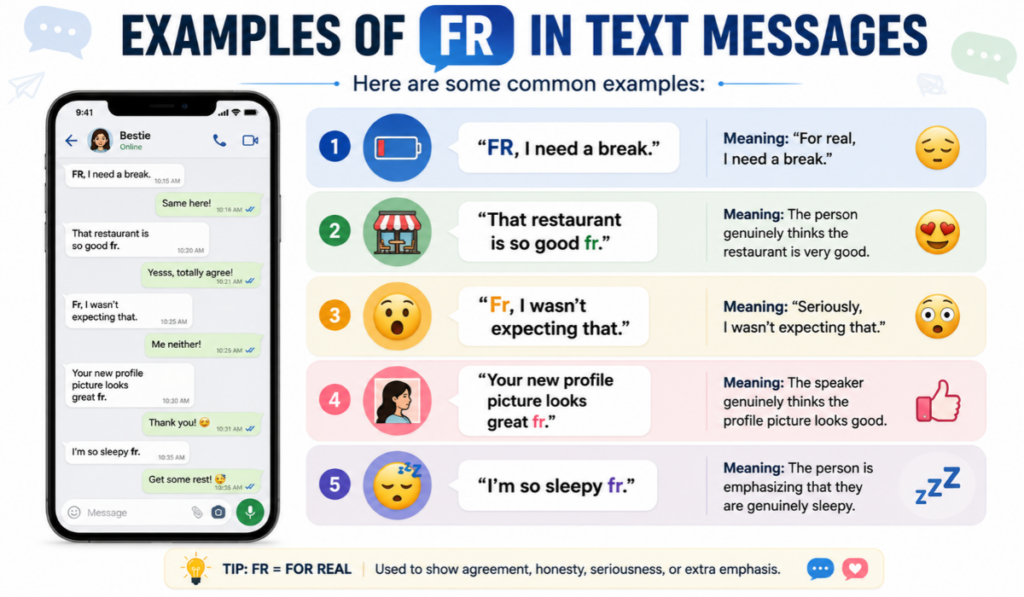
Understanding examples is one of the easiest ways to learn what fr means in text. Because the abbreviation can be used in different positions, looking at several situations can make its meaning clearer.
Here are some common examples:
- “FR, I need a break.”
Meaning: “For real, I need a break.”
- “That restaurant is so good fr.”
Meaning: The person genuinely thinks the restaurant is very good.
- “Fr, I wasn’t expecting that.”
Meaning: “Seriously, I wasn’t expecting that.”
- “Your new profile picture looks great fr.”
Meaning: The speaker genuinely thinks the profile picture looks good.
- “I’m so sleepy fr.”
Meaning: The person is emphasizing that they are genuinely sleepy.
These examples show that FR does not always need to be translated word-for-word. Depending on the sentence, it can communicate ideas such as “seriously,” “honestly,” “really,” or “I agree.”
Read Also: SMD Meaning Text
Examples of FR as a Question
When FR appears with a question mark, it often means “For real?” This form is commonly used when someone is surprised or wants confirmation.
Consider these examples:
- “You got tickets for the concert.”
- “Fr?”
Here, the second person is surprised and wants to know whether the statement is true.
Another example:
- “School is closed tomorrow.”
- “Fr?”
The person is asking for confirmation because the news sounds surprising.
You might also see:
- “Fr??”
The extra question mark can make the reaction appear more surprised or doubtful. Digital conversations often use punctuation to communicate emotions that would otherwise be expressed through voice or facial expressions.
Common Conversations Using FR
FR appears naturally in many casual conversations. For instance, two friends discussing food might have a conversation like this:
A: “These momos are amazing.”
B: “Fr, I could eat another plate.”
Here, B uses FR to agree strongly.
In another conversation:
A: “I’m going to start exercising tomorrow.”
B: “Fr?”
If B is surprised because A has said this many times before, “fr?” can mean “Are you serious this time?”
Another example:
A: “That was the funniest video ever.”
B: “Frfr 😂”
The use of FRFR intensifies the agreement and makes the response feel enthusiastic and casual.
Why Is FR So Popular?
The popularity of FR comes partly from the way people communicate online. Messaging platforms encourage quick responses, and abbreviations save time. Two-letter expressions are especially convenient when people are having fast conversations. Another reason is that internet slang can communicate tone. A person writing “for real” and a person replying “fr” may be saying essentially the same thing, but the abbreviation feels more casual and conversational.
Social media has also helped spread these expressions between different online communities. Terms that begin in one group can quickly become familiar across platforms because users regularly encounter the same slang in posts, comments, videos, and chats. FR is therefore more than just a shortened phrase. It has become part of the informal vocabulary used by many internet users.
Other Meanings of FR
Although “for real” is the most common meaning of FR in texting, abbreviations can have different meanings depending on context. FR may refer to something else in areas such as business, technology, geography, education, or other specialized fields. For example, in a completely different context, “FR” may be used as an abbreviation for a country code or a technical term. The intended meaning should therefore be determined from the surrounding information.
However, if you receive a casual message such as “That was crazy fr,” there is little reason to interpret FR as anything other than “for real.” Context is always important when interpreting abbreviations.
How to Reply When Someone Says FR
Your response to FR depends on what the person is trying to communicate. If they are using it to agree with you, you can simply continue the conversation.
For example:
A: “This weather is terrible.”
B: “Fr.”
A: “I know, right?”
You can also respond with expressions such as “Exactly,” “I know,” “Seriously,” or another opinion.
If someone sends “fr?” because they are asking whether something is true, you should answer the question directly.
For example:
A: “I’m moving to another city.”
B: “Fr?”
A: “Yeah, next month.”
This shows how the same two letters can have different conversational functions depending on punctuation and context.
FR in Gen Z and Internet Slang
FR is strongly associated with modern internet slang and is commonly seen in conversations influenced by social media culture. It is particularly familiar among younger users who frequently communicate through short messages, comments, and online communities.
However, it is not limited to one generation. Internet slang spreads quickly, and people of different ages may recognize or use expressions such as FR, LOL, BTW, TBH, and IDK. The important thing is to understand the audience. Slang can make a casual conversation feel natural, but using too much slang with someone who is unfamiliar with it can create confusion.
Difference Between FR and Other Similar Slang
FR has a few related expressions that can appear in similar situations. For example, “tbh” means “to be honest,” while “ngl” means “not gonna lie.” These expressions can all communicate sincerity, but they are not exactly interchangeable.
FR focuses strongly on being genuine, emphasizing a statement, or agreeing with something. TBH often introduces an honest opinion, while NGL is frequently used before saying something candid or unexpected.
For example:
- “FR, that was amazing.”
- “TBH, I didn’t like the movie.”
- “NGL, I was surprised.”
Learning these differences can make it easier to understand modern texting language.
Common Mistakes When Using FR
One common mistake is assuming that FR always means the same thing. Although “for real” is the standard texting meaning, the exact interpretation depends on the sentence and punctuation. Another mistake is using FR in formal communication. While it may be perfectly normal in a conversation with friends, it can look too casual in professional writing.
People may also confuse “fr” with “frfr.” Although they are related, FRFR adds stronger emphasis. Understanding this distinction helps you interpret the tone of a message more accurately. Finally, avoid assuming that every abbreviation has a universal meaning. Always consider the context, platform, and conversation before deciding what a shortened expression means.
When Should You Use FR?
You can use FR when communicating casually with people who are familiar with internet slang. It works well in text messages, social media comments, direct messages, gaming chats, and informal group conversations.
Use it when you want to:
- Show agreement
- Emphasize that something is true
- Confirm that you are being serious
- React to someone’s statement
- Ask “For real?” when used with a question mark
For example, “Fr, I agree with you” is perfectly understandable in a casual conversation.
FAQs About What Is FR in Text
Q1. What does FR mean in text?
FR usually means “for real” in text messages and online conversations. It can be used to show agreement, seriousness, honesty, or emphasis. For example, “That was funny fr” means the speaker genuinely thought something was funny.
Q2. What does FR mean on social media?
On social media, FR generally means “for real.” People use it in comments, captions, replies, and direct messages to agree with someone or emphasize that they genuinely mean what they are saying.
Q3. What does FR mean when someone says “fr?”
When someone writes “fr?” with a question mark, it usually means “For real?” or “Are you serious?” It can express surprise, disbelief, or a request for confirmation.
Q4. What does FRFR mean?
FRFR means “for real, for real.” It is an intensified version of FR and is used to emphasize that someone is being completely serious or strongly agrees with something.
Q5. Is FR a slang word?
FR is an internet and texting abbreviation rather than a formal word. It is widely used in informal digital communication, including text messages, social media, gaming chats, and online discussions.
Q6. Can I use FR in a formal email?
It is generally better to avoid FR in formal emails. In professional communication, write the complete expression or use a clearer formal phrase such as “I completely agree” or “I genuinely mean this.”
Conclusion: What Is FR in Text?
So, what is fr in text? In most texting and online conversations, FR means “for real.” It can be used to show agreement, emphasize that something is true, express seriousness, or ask “For real?” when written as a question. The abbreviation is popular because it is short, easy to type, and immediately recognizable in many online communities. You may encounter it in text messages, social media comments, gaming chats, direct messages, and casual conversations.
FR can also appear as FRFR, meaning “for real, for real,” which adds extra emphasis. However, both forms are informal and are best suited to casual communication rather than professional or academic writing. The easiest way to understand FR is to look at the context. If someone writes “That food was amazing fr,” they are emphasizing their genuine opinion. If they write “Fr?” they are probably asking whether something is actually true. Once you recognize these patterns, understanding FR in text becomes simple.
Read Also: NTM Meaning in Text || ALR Meaning in Text